
Humility
Living in Christlikeness

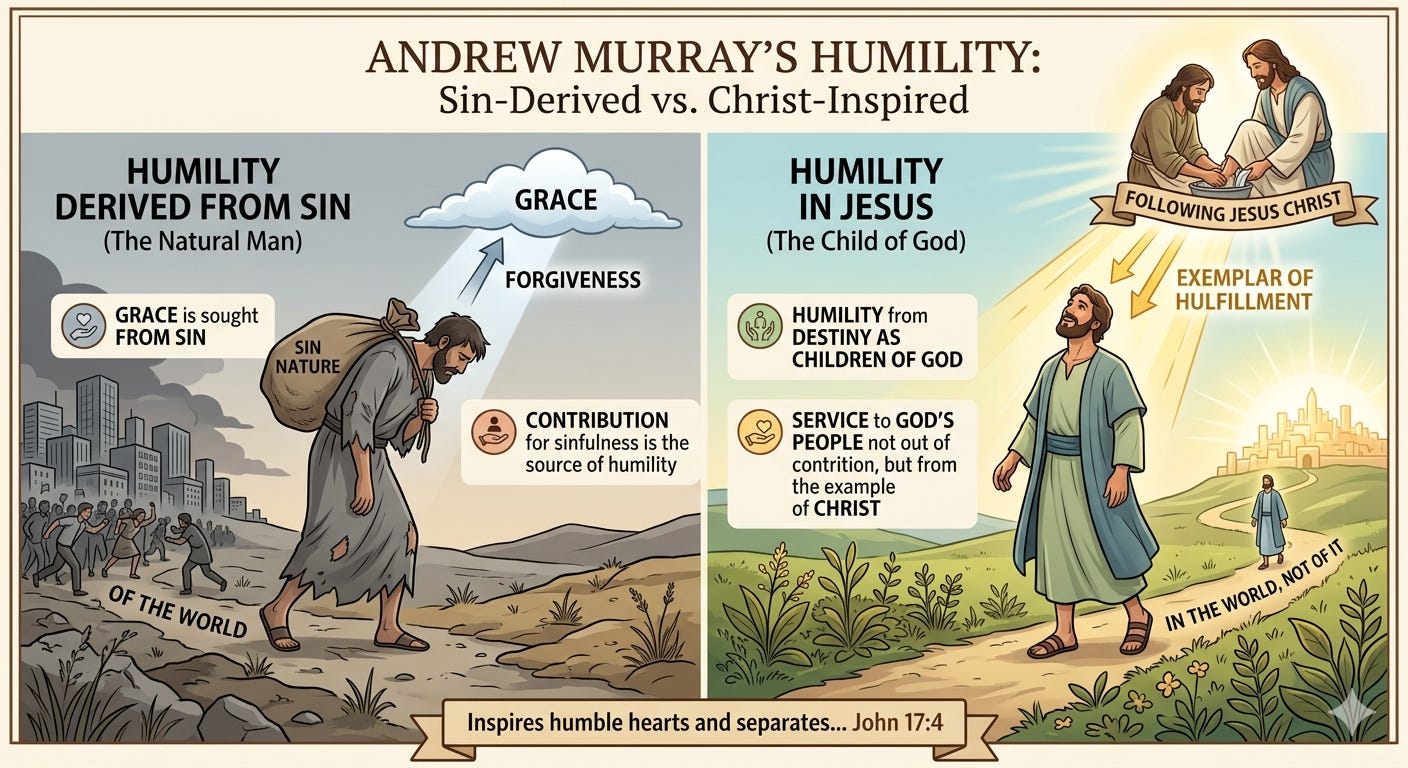
Murray’s Position
In Andrew Murray’s Humility, he argues grace, derived from sin, humbles the soul. He supports his position, citing our sin nature, not faith, as the source of humility and forgiveness.[1]
The faithful serve God’s people humbly, not out of contrition for sinfulness but through Jesus’ fulfillment of their destiny as children of God.[2]
Like | Comment | Share | Subscribe
Following the exemplar of humility, Jesus Christ, inspires humble hearts and separates those in the world from those of it (John 17:4).
Humility Be the First?
Murray’s second chapter, The Secret of Redemption, begins with Philippians 2:5-7. In it, Paul links the first four verses of his humility pericope with its last six, using the fifth verse to turn the exhortation to the Philippian church toward following the Christ’s model of humility vv. 6-8.
The Apostle finishes the passage with an exaltation of the one God, given the name above all names, who obediently humbled Himself unto death before His Father in heaven, vv. 9-11.
In-between vv. 5 and 9 lies Christ’s example of humility, which both Murray and Paul used to motivate their readers toward copying Jesus’ example of humility.
Like | Comment | Share | Subscribe
No doubt God’s people are called to live in Christlikeness (1 Cor 11:1). The Son of God entered the world to atone for His people’s sins.
There is no secret[3] once revealed, enabling us to replicate what the creator accomplishes.
Interpretive Development
Chapter three begins with Murray’s interpretation of John’s Gospel, depicting Jesus as the epitome of humbleness. He views the Father/Son relationship guiding motivation, consciousness, power, and spirit as obvious acts of humility.[4]
The author cites a verse from Matthew’s Gospel to buoy his interpretation (Matt 23:12). In Chapter four, Murray cites nine NT passages, implying humility lies at the center of grace, and the disciples’ lack of it, a sign of their ignorance.[5]
Like | Comment | Share | Subscribe
He explains in chapter five, “The absence of this grace is the secret cause why the power of God cannot do its mighty work,” and inhibits humility within the church.[6]
Speaking of Christlike humility in chapter six, the author urges God’s people not to view interpersonal struggles as vexing, but as opportunities to exercise God’s grace.[7] Murray explains his perspective on holiness in chapter seven; believing it derives from creaturely humbleness.
The author describes it as the “bloom and beauty” of holiness.[8] Supporting the book’s thesis in chapter eight, Murray reiterates the source of humility; penitence and contrition.[9]
He prioritizes humility over faith when speaking of one’s salvation in chapter nine.[10] In Chapter ten, the author explains how walking the path of humility results in the death of self.
Thanks for reading The Flaming Sword
Murray sees one’s death to self, the preparatory work needed prior to receiving God’s grace.[11] He believes Born-Again Believers progress in stages of fear and hope to apprehend happiness through humility, as noted in chapter eleven.[12]
The author explains his view on how to apply Christ’s humility in learners’ lives by using relational opportunities to humble themselves, as the means of grace.[13]
Scriptural Proofs of Humility
Sinful pride stifles our ability to learn from others wiser than ourselves. This aphorism, in combination with Scripture (Pro 15:33; 29:23) supports Murray’s statement, prioritizing humility before grace.
“I dwell in the high and holy place, and also with him who is of a contrite and lowly spirit” (Isa 57:15, ESV). The LORD, who is above and beyond mankind’s physical experience, revives those who humble themselves before Him.
Like | Comment | Share | Subscribe
“Humble yourselves, therefore, under the mighty hand of God so that at the proper time He may exalt you” (1 Peter 5:6, ESV).
Peter speaks to the exaltation of the true penitent and contrite heart, as written about by Isaiah.
Convicting and Encouraging
The reader may find Murray’s fourth chapter convicting. Hearing and reading Jesus’ words remind Believers of their sinfulness.[14]
While it is true some live holy lives outwardly, none can conceal their corrupted heart, mind, and soul from God (Jer 17:19; 1 Tim 6:5-19; Rom 3:10).
It is God’s grace that teaches those separated from Him what genuine humility is: His choice, not our own, to pardon some and not others who receive the justice all deserve (1 John 4:19).
Like | Comment | Share | Subscribe
Murray’s first chapter encourages readers by reminding us why God created mankind;[15] fellowship with His most treasured possession, the remnant (1 Cor 1:9; 2 Cor 13;14; 1 John 1:3).
Fellowship with God means He links Believer’s hearts to His own (Amos 3:3).
Jesus’ sacrificial atonement, His blood, washes sinners’ enmity toward God away, reconciling us with Him (Col 1:21; Rom 5:10), making possible our eternal life in His presence; Father, Son, and Holy Spirit (1 John 5:20).
Like | Comment | Share | Subscribe
[1] Andrew Murray, Humility: The Beauty of Holiness (New York; London; Glasgow: Fleming H. Revell, 1800), 5-6.
[2] Ibid., 6-7.
[3] Ibid., 21, 23.
[4] Ibid., 24.
[5] Ibid., 30-33.
[6] Ibid., 43.
[7] Ibid., 51.
[8] Ibid., 52.
[9] Ibid., 59.
[10] Ibid., 69.
[11] Ibid., 76.
[12] Ibid., 81.
[13] Ibid., 87.
[14] Ibid., 30-33.
[15] Ibid., 11-12.