
Believers' Glorification
Cruciformity

Gorman’s Main Premise
In his book Cruciformity, Gorman focuses on Paul the Apostle’s (c. AD 5–64) spirituality. Today, Paul, Gamaliel’s student, is renowned for his comprehensive knowledge of the law and in-depth theological interpretation of it.
After his Emmaus Road experience and recovery from it, Paul received instruction from Christ while in the Sinai Desert (Gal 1:11-12). Gorman views the crucifixion as the basis of the Apostle’s spiritual foundation for his pastoral approach to ministry.
Like | Comment | Share | Subscribe
The author interprets Paul’s statement to the Corinthians, “For I decided to know nothing among you except Jesus Christ and Him crucified” (1 Cor 2:2), as his proclamation of the crucifixion’s sufficiency.[1]
We can attribute Paul’s interpretation to his unique pre/post crucifixion perspectives harkening back to his statement in chapter 1 v. 23.
The stumbling block and folly references in it make the Messiah’s shameful death on a tree repulsive to both Jews and Gentiles.
In Cruciformity, Gorman’s major premise considers Paul a spiritual pastor over a theological ethicist.[2]
Basis of Premise
Gorman uses the term narrative spirituality to help give depth to his Cruciformity theology, using Paul’s story linking it to his relationship with God.[3]
Paul’s pastoral approach to ministry shows what a Christlike lifestyle looks like for contemporary discipleship to follow.
Like | Comment | Share | Subscribe
The author shows how Paul’s spiritual life reflects the Lord’s servant leadership back into the world, promoting the growth of his kingdom in it.
In 2001, Cruciformity’s publication brought praise to Gorman for his clear, well-researched, and contemporary relevance of Paul, the spiritual pastor.
Gorman’s research revealed others who supported his main premise of Paul’s narrative spirituality and the crucifixion’s role in his ministerial pastorate (e.g., Hays, Crucified With Christ, 1991, The Faith of Jesus Christ, 1983; Fowl, The Story of Christ in the Ethics of Paul, 1990; Witherington, Paul’s Narrative Thought World, 1994).
Supporting the basis of his premise, chapters two through four speak of Paul’s relationship with God. In these Chapters Gorman shows how Paul’s experience derives from the cross.
Thanks For Reading
The rest of Cruciformity explores aspects of Paul’s spiritual story’s development through his understanding of the trinity’s action, faith, love, power, hope, and vision (Chapters 5-13).
The author explains, “Faith is ‘the decisive and most distinctive note of Paul’s spirituality.”[4]
Gorman’s statement suggests he believes Paul’s narrative spirituality conforms to the crucifixion’s moral and spiritual implications.
The author closes the book advocating for contemporary replication of Paul’s cruciform spirituality by following Jesus’ example of servant leadership; bear your own cross and unite within the Body of Christ.[5]
Gorman Makes His Point
Gorman recalls Paul’s description of the Lord’s death in his letter to the Galatians, an example of Jesus’ faith and love in action.
He identifies parallels to it in the Apostle’s Philippian Epistle showing Jesus’ love for God manifests through His love for God’s people (Gal 2:20; Phil 2:3-4, 6-8).[6]
Like | Comment | Share | Subscribe
Gorman’s extensive use of citations and the depth of resources seen in his bibliography support the premise and help to convince readers about the points he makes in Cruciformity.
Gorman and Crucifixion
Gorman’s use of Paul as his exemplar of narrative spirituality in Cruciformity demands the book’s emphasis on the cross.
Like | Comment | Share | Subscribe
Paul writes to a first-century and for a twenty-first century world, emphasizing his pastoral focus: “And I, when I came to you, brothers, did not come proclaiming to you the testimony of God with lofty speech or wisdom.
For I decided to know nothing among you except Jesus Christ and him crucified” (1 Cor 2:2-3). It is Christ’s death on the cross that atones for the Elects sin; the resurrection points to their eternal reward for a job well done (Matt 25:21).
God Revealed Through a Crucified Messiah
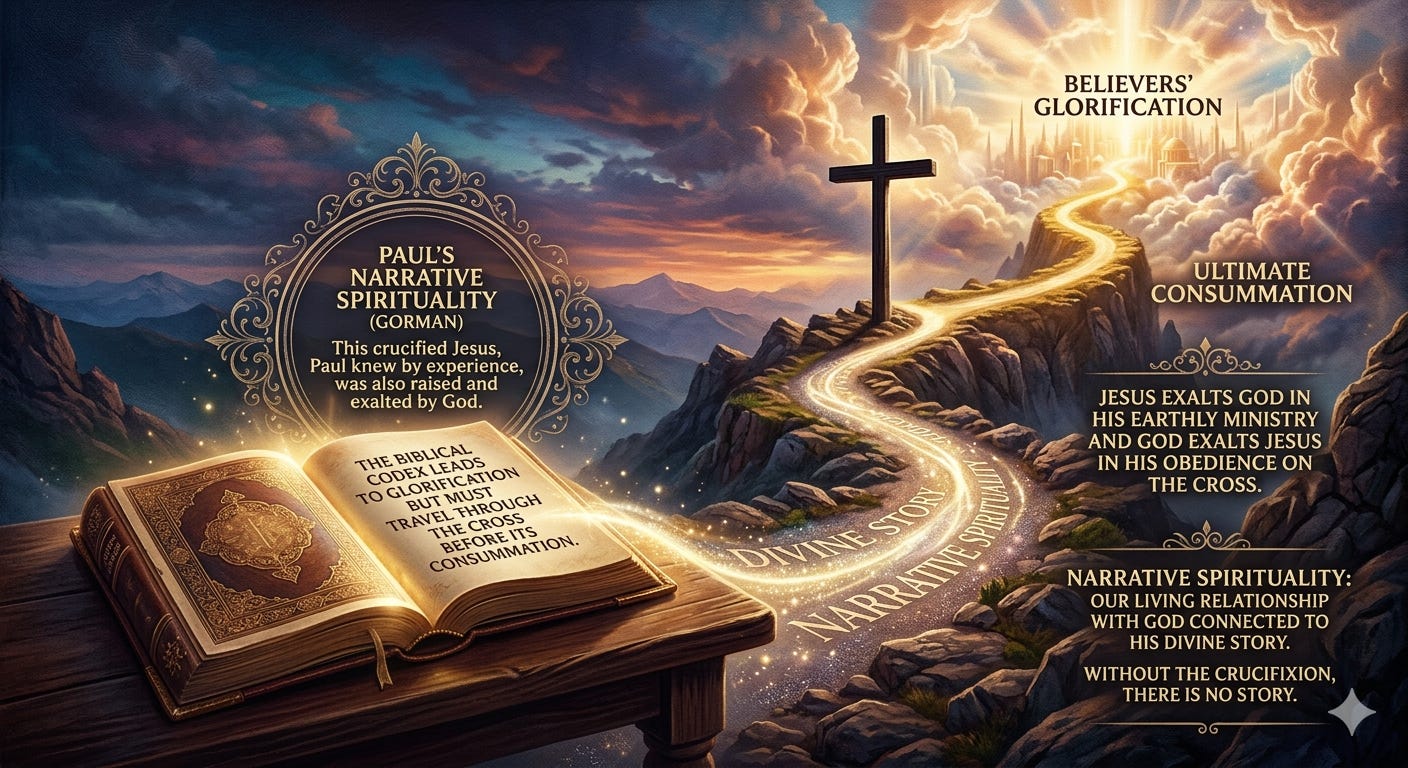
The biblical codex leads to Believers’ glorification in heaven but must travel through the cross before its ultimate consummation.
Your Support Makes A Difference
Gorman’s choice of Paul’s narrative spirituality, a premiere first century Bible scholar, to show “This crucified Jesus, Paul knew by experience, was also raised and exalted by God.”[7]
Jesus exalts God in His earthly ministry and God exalts Jesus in His obedience on the cross. Gorman defines narrative spirituality as our living relationship with God connected to His divine story.[8]
Without the crucifixion, there is no story.
Like | Comment | Share | Subscribe
[1] Michael J. Gorman, Cruciformity: Paul’s Narrative Spirituality of the Cross (Grand Rapids, MI: William B. Eerdmans Publishing Company, 2001), 1.
[2] Ibid., 4.
[3] Ibib., 400.
[4] Ibid., 122.
[5] Ibid., 381.
[6] Ibid., 168.
[7] Ibid., 19
[8] Ibid., 400.